أهلاً و سهلاً
Political Scientist · Princeton University
Postdoctoral Research Associate at the Princeton Institute for International and Regional Studies (PIIRS)
Ph.D., Political Science · University of California, San Diego, 2025
My research examines the politics of exclusion and inclusion in post-authoritarian and post-conflict settings. One strand of my research agenda investigates how exclusion manifests in these contexts, who is marginalized from the political order, through what mechanisms, and with what consequences for state-building and democratization.
A second line asks how political and social institutions can be designed, and how actors within them can be leveraged, to promote inclusion and overcome entrenched patterns of marginalization.
My regional focus is on the Middle East and North Africa (MENA). My research has been conducted in Afghanistan (prior to the Taliban takeover in 2021) and Iraq, with ongoing projects currently underway in Syria and Libya.
I employ a multi-method approach, combining experimental, observational, and qualitative methods to examine patterns of discrimination, reintegration, and reconciliation in post-conflict settings. I place a strong emphasis on fieldwork in the countries where I conduct surveys/experiments, often making multiple trips and speaking the local languages.
My research has received funding from the Carnegie Corporation of New York, the American Political Science Association (APSA), the National Association of University Women (NAUW), Research on Middle East Political Science Grant, the Arab Fund and the Kuwait Fund for Arab Economic Development.
Book Project
My book project examines how wartime affiliations shape the trajectory of post-conflict recovery. The first part of the book develops a grounded theory of collaboration as a fluid and politically contested category, asking who is considered a collaborator, who decides, and how those judgments vary across actors and settings. Drawing on more than 200 interviews with civilians and elites in Afghanistan and Iraq, as well as eight large-scale conjoint experiments in Iraq, I show that label of collaboration is not always based on verified evidence but instead rely on socially constructed cues such as ethnicity, kinship, or rumor, with profound consequences for reintegration.
The second part of the book investigates how these judgments shape key domains of postwar governance—electoral preferences, public goods distribution, and elite cooperation—using survey experiments, observational data, interviews, and a lab-in-the-field experiment. I find that the label of "collaborator" generates persistent patterns of exclusion: voters penalize candidates with collaboration histories, politicians avoid allocating resources to neighborhoods associated with collaborators, and elites hesitate to cooperate with peers carrying this stigma.
Are voters in multi-ethnic post-authoritarian democracies willing to support candidates who collaborated with the former regime, and how do shared identity concerns shape this? I examine these dynamics using a conjoint survey experiment conducted in Kabul, Afghanistan, prior to the collapse of Afghan democracy. I find that collaboration reduces the reported willingness to vote, while shared ethnic identity increases support for candidates, and the interaction between the two reveals a moderating effect of co-ethnic identity on the negative effects of collaboration.
(with R. Aldulaimi)
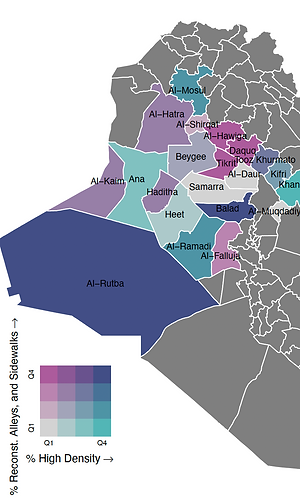
Under ReviewWill post-conflict societies include individuals who collaborated with the losing side of a civil conflict in reconstruction efforts? We argue that patterns of inclusion change when authority over reconstruction rests with local politicians. We evaluate this in Iraq using observational data from 741 neighborhoods, a conjoint experiment with 398 local politicians, and interviews with 50 local politicians.
(with R. Aldulaimi)
Under ReviewHow does a politician's willingness to cooperate change when their peer has a history of collaboration with the losing side in a conflict? We address these questions using a multi-method research design in Iraq, combining a lab-in-the-field experiment and qualitative interviews, both conducted with elected politicians.
Syria & Libya
"Trust, Legitimacy, and the Reintegration of Former Collaborators"
"Elite Signaling and Collaborator Reintegration in Libya and Syria"
Fieldwork OngoingSyria & Iraq
"Neighborhood Inequality and Electoral Behavior" (with M. Abuzaid)
"Economic Exclusion and the Dynamics of Violence" (with M. Abuzaid)
"From Margins to Movement" (with M. Abuzaid)
Fieldwork OngoingMy teaching philosophy centers on fostering an inclusive and intellectually stimulating classroom where all students feel empowered to engage with complex ideas. I aim to create an environment that encourages curiosity and critical thinking through open discussion, diverse perspectives, and thoughtful inquiry. I view teaching as a shared process of exploration, where my role is to guide discussion, pose challenging questions, and support students as they refine their understanding.
Co-Instructor of Record
This course offers a comprehensive introduction to the contemporary politics of the Middle East and North Africa (MENA). It brings together empirical studies of both domestic and transnational political developments in the region with critical engagement of recent political science research. Organized around enduring debates: What drives protest movements under authoritarian rule? Why has the MENA region remained largely authoritarian? What enables or hinders successful democratic transitions?
Co-Instructor of Record
This course provides an overview of the causes, forms, and consequences of political violence, with a focus on both theoretical debates and empirical studies. It introduces students to civil war, insurgency, terrorism, state repression, and genocide—while critically engaging with recent political science research.
From serving as a Co-Instructor of Record and Teaching Assistant
Narmin provided detailed feedback on exams at the request of students. Narmin offered several opportunities to meet with students outside of class to discuss course materials and preparation for examinations.
Narmin was very knowledgable and showed command of the course materials and concepts. Narmin supported active participation and engagement which is always a challenging tasked during remote discussions in the morning.
She developed engaging questions applying to the material while also tying in current events topics nationally and internationally. Very knowledgable, approachable, and helpful.
Narmin is extremely understanding, engaging, and sociable. She always helped to support developing discussion/conversation in class and would have very interesting anecdotes to help us contextualize what we were learning.
Narmin was very clear with what she wanted to see and what structure she expected for core assignments. Her guides for each assignment were extremely helpful. I was never at a loss for what I needed to do.
Narmin gave amazing feedback on all of my essays, that helped me to improve my writing with each submission. Very kind and helpful, and always available and accessible.
Narmin was one of the best TAs I have had. She explains things very bluntly, allowing students to understand the points she is making—a pretty straightforward TA with the proper knowledge of the course.
Greatest strength was her ability to create a welcoming fun environment. She sparked very interesting and engaging discussions amongst the students. Extremely supportive, caring, thoughtful, and encouraging.
العراق
I collected observational data from over 700 neighborhoods across five provinces in Iraq. I tracked reconstruction efforts specifically funded by the Iraqi government, intentionally excluding projects funded by the UN, NGOs, or other external organizations. The focus was on two types of reconstruction projects under the control of local politicians: (1) the reconstruction of alleys destroyed by Daesh and (2) the creation of safety patrols.


افغانستان
Before the Taliban takeover, I collected data in Kabul using various Islamic ledgers that the Taliban had maintained to record the collaboration of civilians and political elites in the city. These ledgers contained detailed information, including names, ethnicity, province of origin, and the capacity in which individuals collaborated with the Taliban.


I place a high value on fieldwork, which has been central to both my dissertation and ongoing book projects. I have conducted research in Afghanistan and Iraq as part of my studies on voting for collaborators, selective reconstruction, and elite cooperation—studies that form the second part of my book, Rebuilding After Conflict: Origins and Legacies of Collaboration. Fieldwork is not just a method for me, it is an integral part of how I generate meaningful and contextually grounded scholarship.

.jpg)


.jpeg)


For inquiries regarding research collaboration, speaking engagements, consulting, or academic opportunities.
Louis A. Simpson International Building, Princeton University